Monthly Program
Programs are open to the public, and all are welcome.
Social Hour at 6:30pm / Program at 7:00pm, on the 4th Tuesday of each month.
Whatcom Museum Old City Hall Rotunda Room
121 Prospect Street, Bellingham 98225
October 27, 2026
Monet, Me, and the Mallards
Gregory Green, Wildlife Biologist
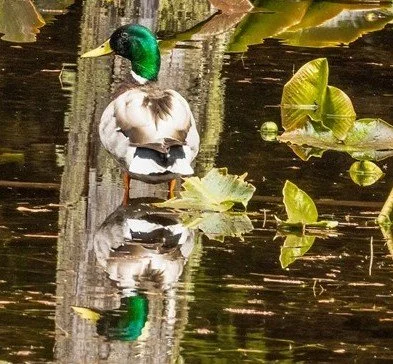
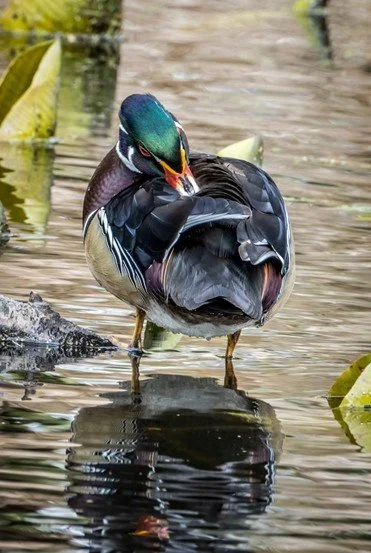
Gregory Green will present a slide show entitled Monet, Me, and the Mallards where he shows how he melded water reflection landscape photography, reminiscent of Claude Monet’s Water Lilies series, with wildlife photography featuring waterfowl and other pond-based wildlife. Forced to quarantine during the COVID pandemic, Greg spent many mornings and evenings within isolated photo blinds capturing both the daily and seasonal vagaries of reflected light upon the water complemented by the presence of alluring waterfowl such as wood ducks and hooded mergansers.
Inspired by the colors and patterns of light reflecting on water, and motivated by his professional background as a wildlife biologist, Gregory melds his photography of attractive waterfowl with an appealing landscape motif. He also discusses the importance of camouflage, patience, and understanding of the habits of waterfowl, and predicting the daily and seasonal changes in reflected light.
Gregory Green is a career wildlife biologist and instructor at Western Washington University, where he teaches ecology, wildlife techniques, and natural history. He is also a nature photographer and writer and recently published the book Wild Lives with Art Wolfe, highlighting the state of the world’s wildlife through photography and essays.
September 22, 2026
Sandpipers’ Last Supper:
Roberts Bank Terminal 2 at the Fraser River Delta
The End of the Road for Sandpipers?
Pat Baird, Researcher and Professor
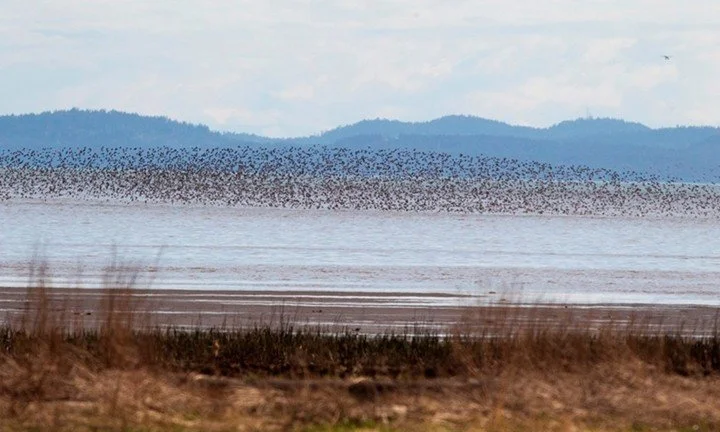
Roberts Bank is the last major foraging area for dunlins and western sandpipers before the nonstop long-range flight to their breeding grounds in Alaska. Here they feed down the food web on diatoms, microphytoplankton suspended in biofilm on the mudflats. Diatoms are one of the few life forms that can produce omega-3 fatty acids such as EPA, and recent research has found that this nutrient is necessary for reproduction and growth in all animals. It is also critical for sandpipers’ ability to make the 1800 km trip to Alaska. It is no coincidence that shorebirds, Fraser River salmon, and orcas migrate past Roberts Bank at the same time every year, because this is when diatoms produce the greatest amount of EPA.
Pat Baird will begin the evening discussing how this system works and why Roberts Bank is so important for shorebird migration, how it differs from other mudflats, and how construction of a container super terminal at Roberts Bank will have significant adverse and cumulative effects on western sandpipers, Fraser Chinook salmon, and Southern Resident killer whales.
The introduction will be followed by a short film by the award winning documentary filmmaker Isabelle Groc and a Q and A session.
Pat Baird has studied population ecology and food webs in both marine and freshwater systems, concentrating on seabird ecology and shorebird migration in many places, from Alaska to California and Hawaii to Panama, Argentina, Mexico, and British Columbia. She was a research scientist for the U.S. Fish and Wildlife Service/U.S. Geological Survey, and a post-doc at the University of Washington (Magellanic penguins in Argentina), and at the University of California (bald eagles and ospreys in the Sierra Nevada mountains) before becoming a professor and researcher in the Biology Department at California State University. There she and her students conducted studies on the ecology of endangered least terns and migration of western sandpipers.
More recently she has collaborated with Simon Fraser University in Vancouver on migration studies to determine the current migration path of the western sandpipers, and to detect differences in stopover areas, foraging areas, or travel times and subsequently, why shorebirds stopped in some areas and not in others. Pat now studies the marine food web at the last staging area of the western sandpipers in BC -Roberts Bank- before the shorebirds’ long hop to their breeding grounds in Alaska.
Her most recent publications include review papers demonstrating that omega-3 fatty acid micronutrients are critical not just for shorebirds, but also for the entire marine food web- in estuaries and in the Arctic.